
Decolonising A Bookshelf
Kate Larsen
Reading is my only competitive sport (though one in which I only compete with myself).
Over the last decade, I’ve read an average of 3 books a week, or more than 150 books every year. From romance and fantasy, YA and literary fiction, poetry and political manifestos, my reading is perhaps best characterised as ‘eclectic AF.’ But it wasn’t until I started work within Australia’s literary sector that I realised how narrow this reading really was.
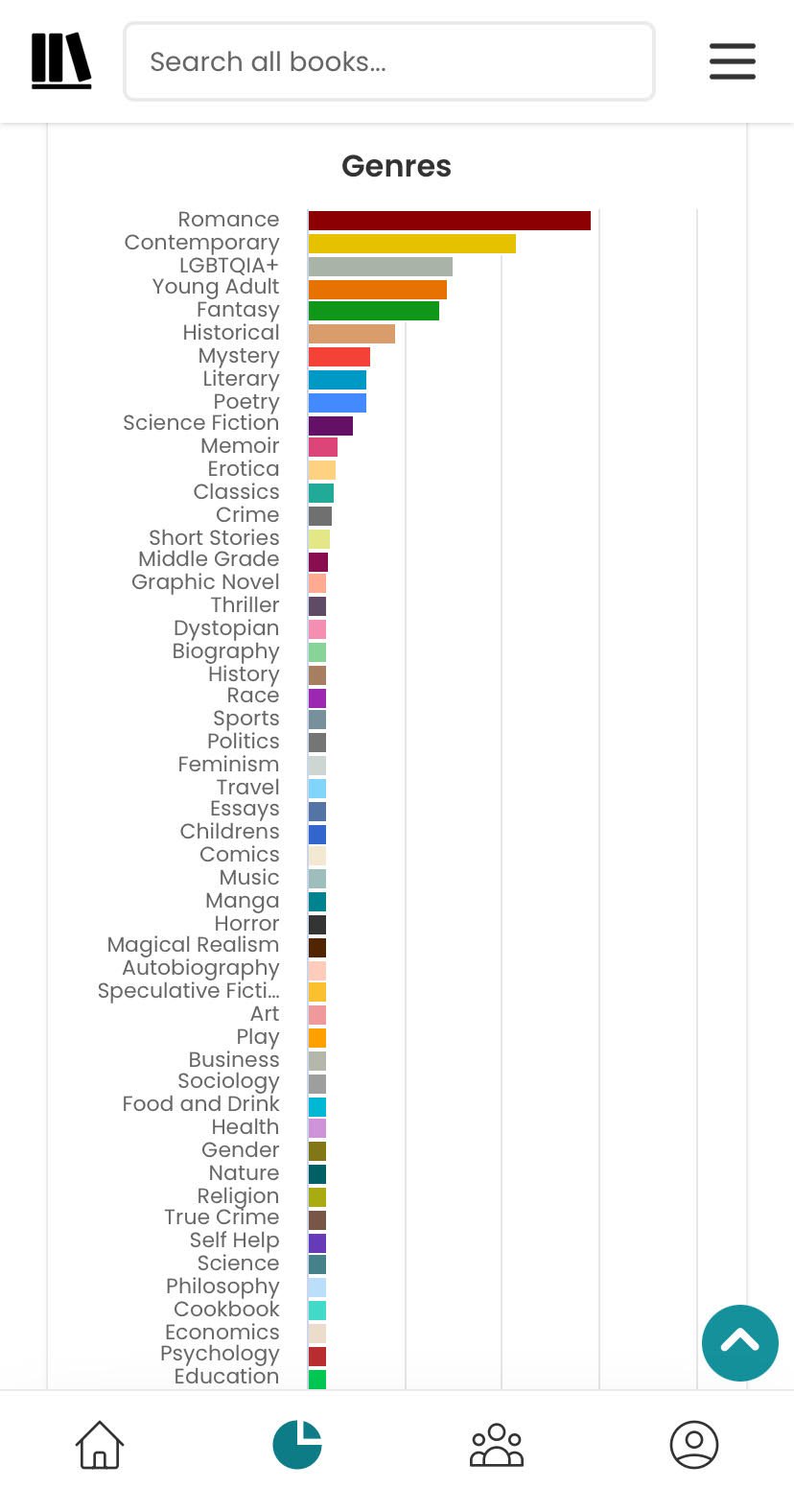
A snapshot of my reading genres
#WeNeedDiverseBooks
Literature is one of Australia’s most monocultural artforms. According to a 2022 report from Melbourne University and the Australian Publishers Association, our sector is mostly made up of young, white, educated women based in Sydney and Melbourne.
While we are finally seeing some diversification of the authors and stories they publish, these are also still fairly homogenous. The first ever First Nations and People of Colour (FNPOC) Count from Victoria University showed only 7% of 1,500+ books published in Australia in 2018 were written by people of colour – and even fewer by First Nations, deaf or disabled authors, or those from other under-represented groups.
Within this bland publishing picture, the romance genre is often critiqued for its own diversity issues: which have sent male/male (MM) romance books written by and for straight, white cis women to the top of gay romance charts, led to the suspension of Romance Writers Australia’s Diverse Romantic Book of the Year prize after a shortlist of entirely white authors, and punished those who have spoken out about racism. Meanwhile, BookTok and Bookstagram are awash with excuses from white romance readers who ‘can’t relate’ to the work of authors of colour, while happily devouring books about fated mates, spicy fairies or gay male hockey players even further away from their experience.
Since becoming aware of this white-washing, I have made a conscious effort to bring my reading lists closer to real life: not in terms of content (I read about too many dragons and happy-ever-afters for that), but which authors I read and which stories informed by authentic lived experience.
This is the key message of the international #WeNeedDiverseBooks campaign, which calls for more books where: ‘people of colour can be first-page heroes rather than second-class citizens. Books in which LGBTQIA+ characters can represent social change rather than social problems. And books where disabled people can be just… people.’
Unfortunately, it seems a few years of reading more diversely wasn’t enough to shift the habits of a lifetime. Two years ago, I divested from Amazon’s Goodreads to Storygraph, created and owned by Nadia Odunayo, a Black British software engineer, which crunches reading lists into all sorts of wonderful graphs. In my case, its summaries of decades of reading data showed my annual reading had indeed diversified, but my list of Top 10 most read authors did not include a single racialised writer (while unfortunately containing some problematic authors I’d prefer were no longer there).
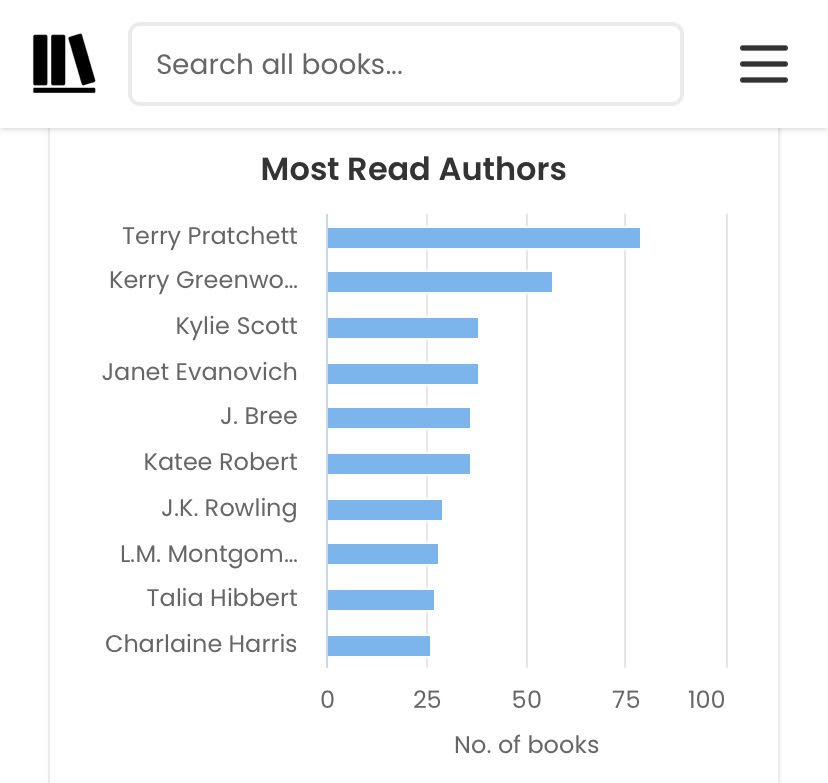
My top ten most read authors (some represent historical reading, rather than current)
Race is a social construct and only one of the intersecting experiences I’m trying to find on the page. But the experience of racism is not only real, but actively informs who works in publishing, who gets published, who edits, markets, reviews and judges their books, who gets stocked in bookshops and libraries, who gets programmed in literary festivals or included on reading lists, who hits bestseller lists, and, ultimately, who gets read.
We need more racialised romance
Aiming to read more diversely can (and should) be applied to all genres, topics and literary forms. But when looking at the microcosm of racialised romance, it’s particularly pleasing how many synonyms apply. Which allows me to talk about how I use a number of reading challenges to engorge, expand or grow my reading lists. To open, spread or swell. To thicken, unfold or unfurl.
For high-bookcount reading addicts like me, I highly recommend The Diverse Baseline reading challenge to read at least 3 books by racialised authors each month.
I am in my fourth year of BookRiot’s Read Harder Challenge, which invites readers to explore formats, genres and perspectives that go beyond their reading comfort zones.
The 2026 Book Bingo from my fave Naarm/Melbourne bookstore, Amplify, only stocks books by BIPOC authors and encourages you to read the books already on your bookshelves.
You can also design your own DIY challenge, like my personal commitment to read at least 1 Blak Book by a First Nations or Torres Strait Islander writer each month.
Or follow readers or authors you know on Storygraph and read what they read and recommend.
Thanks to initiatives like these, one of my Top 10 most-read authors is now a racialised romance writer: UK novelist Talia Hibbert (who also writes beautifully from a lived experience of disability).
This diversification is about more than just numbers. With racism and religious intolerance on the rise in Australia, alongside the highest rates of censorship most of us have known, being a pro-active ally for racialised authors and the work they produce has never been more important. Not just to ensure all Australian stories are told (and told well), but for our own sakes – including non-Indigenous white migrants like me. To expand our understanding of the world. To learn and empathise. To push back against xenophobia, fear and fake news. To find the tools we need to imagine a better collective future.
But it’s also about joy.
As US fantasy author Tracy Deonn reminds us in Legendborn, her reimagining of the Arthurian legends as a racist magical fraternity (complete with young MFM love triangle): ‘Don’t make your life about the loss. Make it about the love.’
So I’ve made my reading about more.
About Hibbert making me laugh out loud with swoonworthy contemporary romances about dating with chronic illness and mental health issues. About Wiradyuri writer Anita Heiss and Bigambul and Wakka Wakka writer Melanie Saward exploding stereotypes of modern First Nations women with internationally jet-setting protagonists. About Uzma Jalaluddin and Sonali Dev using Jane Austen-inspired meet-cutes to invite us into Canada’s Muslim community or the Desi-American diaspora. About the swagger and sexiness of Chencia C Higgins’ and Nisha Sharma’s FF and MF romances. And even about the (im)possible futures of fantasy, speculative or science fiction romance writers that don’t necessarily depict a lived experience of racialisation, such as the empathy-as-superpower Psy-Changeling series from New Zealand-based Nalini Singh or the spicy monster Mead Realm Tales from US author Kimberly Lemming.
Not to mention the young adult romance writers at the cutting edge of social and relationship dynamics and perspectives on the world. Like Yuin writer Gary Lonesborough and Nukunu writer Jared Thomas’s young MM and MF love stories from regional Australia. Or Palestinian-Australian Randa Abdel-Fattah setting When Michael Met Mina on opposite sides of an anti-immigration rally. Or the many faces of young queer love found in books by Bangladeshi-Irish author Adiba Jaigirdir and US-based Adib Khorram, Julian Winters, Kacen Calender or Sonido Reyes. Or in the fantastical imaginations of Aidan Thomas, Kalynn Bayron, Tahereh Mafi or Tracy Deonn.
For entertainment, education and empathy, we have never needed these authors more. As Hibbert writes in Get a Life, Chloe Brown: ‘Bliss should be held on to with both hands.’
__________
Kate Larsen (she/her) is an arts, cultural and non-profit consultant and writer currently based on unceded Wurundjeri Woi-wurrung country in Naarm/Melbourne. Her work has been published by The Relationship is the Project, Meanjin, Overland, Griffith Review, Westerly, Cordite, Kill Your Darlings, Voice&Verse and anthologies, magazines and arts organisations in Australia, Asia and the UK. Kate’s debut collection of poetry, Public. Open. Space., was published by Fremantle Press in 2023. Find her at @KateLarsenKeys